Overcoming Spiritual Anxiety + Scrupulosity

When I was 30 years old, my life was turned upside down by a personal encounter with Jesus and an unexpected conversion to Christianity. I became “religious” and quickly began to change certain things about my lifestyle. I traded breathwork ceremonies for church on Sunday, oracle cards for Scripture, sexual promiscuity for waiting until marriage. I suddenly became aware of a law I’d never consciously acknowledged before. There was, apparently, a right way to do things. There were rules for life. I was eager to conform to them.
But I became lost along the way.
My heart had been captured by the grace and truth of Jesus, the Savior of the world. But slowly, almost undetectably, I became consumed by an anxiety-driven effort to save myself. Rather than fix my gaze on Jesus, my gaze became fixed on the law (or morality) and my frightful uncertainty about whether I was fulfilling it. I was tormented by doubts about whether I’d sinned or was sinning or was truly saved. I tried desperately to self-soothe by over-thinking every single thing, confessing sins I wasn’t sure I’d committed, and avoiding anything that might trigger my insecurity.
Two years later, I sat crying across from a pastoral counselor and told her, “I feel more trapped now than I ever did before becoming a Christian. I don’t feel free.” Just saying the words aloud, I knew something was wrong. It is for freedom that Christ has set us free. Why do I feel like this?
Intrusive thoughts, overwhelming fear, and desperate attempts to make them go away had plagued me since I was twelve. My anxious, obsession-prone mind had fixed itself to many different things over the years — doubts about losing my Mom, dying of a heart attack, contracting rabies, developing early-onset Alzheimer’s, not loving my boyfriend enough. I’d been diagnosed with OCD not even a year before I became a Christian. It didn’t occur to me that my new obsession was a continuation of that condition. The same deeply engrained fear, insecurity, and self-reliance that had driven my OCD for years, was now driving my scrupulosity (aka. religious OCD.)
My relationship with Jesus, with God, had been hijacked.
That was three years ago. This is what I’ve learned about overcoming spiritual anxiety and scrupulosity.
Religious OCD as Relational
OCD is multifaceted (check out this free training to learn about it in-depth), but my goal here is to hone in on the relational aspect of OCD. The driving anxiety, distorted thoughts, and compulsive, control behaviors that make up this condition are deeply connected to our relational lives. Let me explain.
The Fear
Our feelings, especially of safety, are shaped by relational experiences. Don’t get me wrong - there are other factors that shape our feelings. But how we are nurtured (or not) significantly impacts how our brains and feelings develop. Studies show that anxiety is directly, positively correlated with how insecure we are in our relationships - that is, how seen, cared for, and safe we feel in them. People who feel deeply afraid in the world are often those who have been deeply insecure and/or wounded in relationships. How anxious we feel is directly correlated to how alone we feel, have been, or have believed ourselves to be. Our fear has something to say about our relationships with other people and with God.
The Thoughts
From our earliest moments, our internal ‘stories’ are shaped in relationship with others. Automatic, intrusive, and/or doubt-filled thoughts reflect what we’ve been told, shown, and have believed in our relationships. These stories can be twisted, incomplete, and/or unreliable. For example, our conscience - what we feel and believe to be good and moral, or the opposite - is influenced by those around us, especially those who have had power to discipline us. Beyond the content of our thoughts, the amount of attention and weight we give to our thoughts also has something to say about our relationships. Many of us who have suffered with forms of OCD give a great amount of attention and assign a great deal of weight to our thoughts. More than they are worth. This relationship we have with our own thoughts reflects something about our relationships with others and with God.
The Compulsions
Compulsions are the internal and external ways we try to self-soothe. They are driven by our big fear and faulty stories, including about what is moral. Because of this, they are sometimes an attempt to correct and atone for something that God isn’t actually asking or requiring of us. We attempt to do this by relying only on ourselves (hyper-independent) or by overly relying on another, limited human being who isn’t and can’t be God for us (codependent.) Often, these are behaviors we’ve seen modeled in our close relationships.
When you look at the obsessive compulsive cycle of religious OCD relationally, you can approach healing relationally. In my experience, this changes everything.
Religious OCD + Your Relationship with God
More than any other form of OCD, religious OCD is deeply connected to our relationship with God. When distorted beliefs about God (and what he requires of us) live in our bodies, minds, or hearts, these beliefs show up as scrupulosity.
For example, many religions teach some version of this belief…
“If you follow these rules, you’re good. If you’re good, you’re loved.”
Many of us have this sort of relationship with God, including Christians. Sometimes we don’t even realize we’re living from this belief. But we are and it’s no wonder we’re anxious because the truth is: All of us break the rules. None of us are good in that sense. But we need to be loved, and be secure in that love, if we have any hope of being good or following them.
People suffering with religious OCD often have what’s called an insecure, anxious attachment with God. This means we don’t feel fully safe and secure with him. We want to be close to him, yet we fear he’ll abandon us. This makes us hyper-vigilant to anything that could threaten our relationship with God, including our own inadequacies and failures. We have a fear of messing up, making him mad, and being rejected.
This is often an anxious, calcified residue from real experiences we’ve had in relationships. We’ve experienced abandonment or rejection from others we’ve been close to. Perhaps even seemingly small mistakes brought swift punishment. Perhaps those close to us have been quick to judge or have lacked compassion or mercy. Our experiences of imperfect, insecure love can easily misshape our understanding of God and what it’s like to be in relationship with him.
Rather than go to him with our ugly, unwanted thoughts, fears, and failures, we hide and try to deal with them ourselves. But this just leaves us more insecure, afraid, and stuck in a vicious cycle.
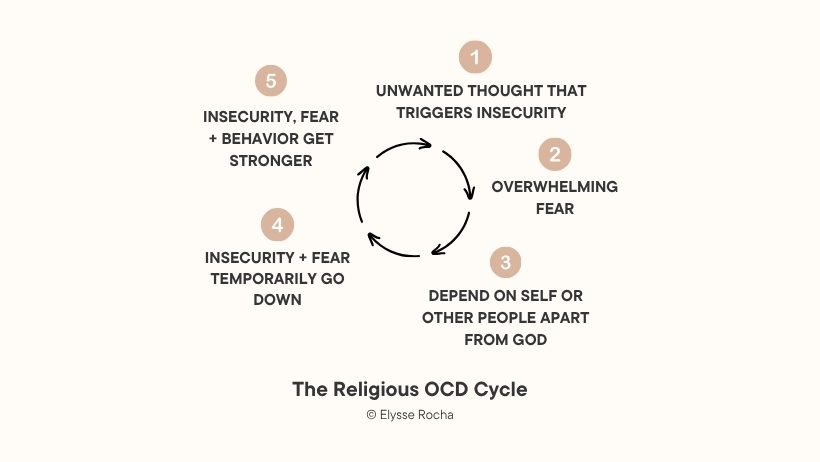
The thing is, God doesn’t want or expect us to clean up and then come to him. We are invited and safe to come to him with our mess - in fact, that’s the only way we can get cleaned up!
Replacing Lies with Truth
Religious OCD is driven and sustained by distorted beliefs, and it’s disrupted and overcome by the opposite. We need to know the truth - in our bodies, our minds, our very cells and center.
When I was suffering with scrupulosity, I was deeply afraid of making a wrong step or missing something. Having thoughts I hated in my head felt life-threatening. I was afraid that God would harshly punish, reject, and abandon me for any misstep. I didn’t feel safe.
This was right after Jesus came and met me with compassion while I was making countless, sometimes even partly conscious, missteps. When I wasn’t good or following his rules is when he showed up and loved me. I couldn’t see how my fear contradicted my actual experience with God.
The truth is we have messed up. If the only way we can be loved is by being good, and the only way we can be good is by following the rules, we are in big trouble. We know deep down that we have not followed the rules. We are fearful and rebellious and frequently fail at doing the right thing. We have felt, thought, and done wrong. And if we believe in justice, we do deserve to pay. Some part of us knows the weight of our wrongs and what we’ve earned.
This can feel scary to acknowledge, but it is ultimately freeing.
Why? Because it’s not the whole story.
The Truth of Jesus
The truth that Jesus offers is that we were created to be good, in God’s image, and have been loved from the start, before we ever followed or disobeyed any rule. God’s love is not something we can or have to earn, it’s something that’s been ours all along.
Part of his love for us has involved good rules. Just like I have a rule against my dogs, Bailey and Banjo, eating chocolate because I know it would harm them, God has had rules for us and for our protection. Yet, at one point, we decided to not trust or follow his rules. We were lied to by someone else, and did wrong. This has distorted our minds, bodies, and lives into something not-so-good anymore. We follow our own way instead of his. We hurt ourselves and others, and struggle with things like religious OCD.
The truth is: We have been so afraid of being abandoned by God, but we are the ones who abandoned him.
Yet, even so, God has not stopped loving us. On the contrary, he gave us his precious Son, Jesus. He offers us not only forgiveness, but healing for our broken hearts. He doesn’t love us once we get good and follow the rules, but while we are sinners. We are loved in the moments we deserve it the least. He has made a way for us to be restored back to our original goodness - not by trying our hardest to follow his rules, but by being loved by him through his Son, Jesus, and choosing to trust him again.
When we accept Jesus, we get to be free. Not because we don’t mess up, but because he doesn’t. That’s the the hope he offers:
You are loved by God, even when you aren’t good and you aren’t following the rules.
Religious OCD tempts us to place our hope in the wrong place. It tempts us to try to find peace in our own performance. In having perfect feelings, thoughts, and behavior. But as you’ve probably realized, this can never work. Jesus invites us to look to something, or someone, far more stable and secure: himself.
When we’re obsessing about whether we’ve messed up in God’s eyes, are overwhelmed by a fear of being condemned, or are trying desperately to be perfect to avoid punishment, we’ve either forgotten or rejected the truth that God loves us so much, he sent his Son. Our hope is in Jesus - the perfect life he lived, the price he paid, and the enemies he defeated and will defeat. Not in our own performance, punishment, or power. True peace comes from resting in his work. Not trying to earn it through our own.
We don’t need to fear abandonment. We need to see and believe that he hasn’t abandoned us.
The ultimate lie of religious OCD is that we can earn God’s love, approval, and safety. But the truth is, because of our sickness, we can never earn it and the good news is, we don’t have to. In Jesus, we are loved, approved, and safe, and these can’t be taken from us. To know this is our ultimate freedom. The more we know and trust him, the less anxious and insecure we’ll be.
Knowing + Trusting That God Is Secure
How do we show and teach our bodies, minds, and hearts the truth?
We need every part of us to know that we do mess up, and God doesn’t abandon or give up on us. We do have distorted feelings, thoughts, and reactions that need transformation, and God already knows and will heal us. Our job is to trust him, follow his lead, and find the peace we’ve been looking for in our compulsive, self-soothing behaviors.
In the simplest terms, overcoming scrupulosity is about knowing and resting in God’s love in Jesus. Our primary job is to know we’re loved. Our most important “work” is to rest in what his work has secured for us.
And it is work for those of us who are so used to trying to earn, secure, and hold on to insecure love. Our bodies, minds, and hearts need renewing.
This is why, after I came to know and believe in Jesus, I very nearly abandoned the original truth that set me free. I began to rely on myself to save me, instead of my Savior. Even though he loved me first, when I was lost and far away from him, I got swept up in the lie that I had to somehow earn his love and get him to stay.
Even when we do believe and have made a decision to trust Jesus, unbelief still lives in us. It lives in our bodies, our nervous systems, our automatic thought patterns, and our reactions. Our spirit may be willing, but our flesh is weak! We can be vulnerable to familiar, false gospels that make us believe we can or have to save ourselves. We have to actively remain in the truth. Regularly “work” to let our anxious hearts rest. Thankfully, Jesus gives us the Holy Spirit to fill and fuel us to do this work.
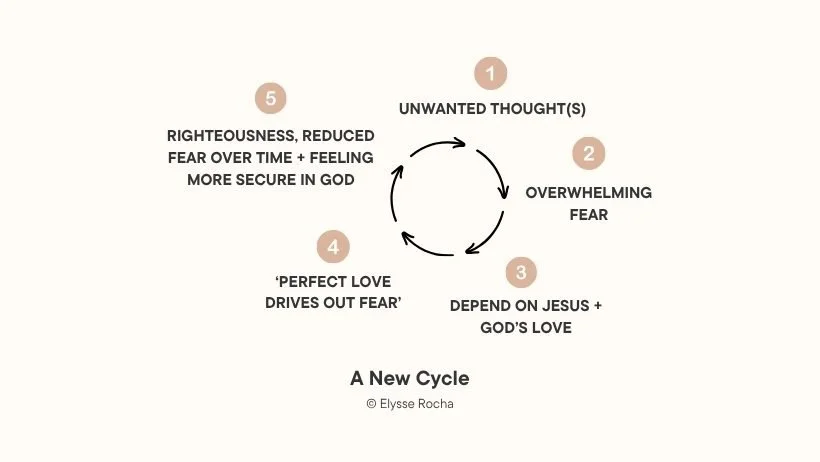
Rest In the Love of God
How do we rest and remain in the truth of Jesus? Here are some ways:
Accept the reality of your guilt + sickness, and the Good News of complete forgiveness + healing given to you in Jesus
Practice stillness + slow, intentional breathing that shows your body you’re safe
Practice focusing your mental gaze/attention on something better + more beautiful than your thoughts (ex. a crucifix, Scripture)
Spend time (slowly) reading + meditating on Scripture
Bring your honest fear, insecurity, questions, and doubts to Jesus in prayer
Take specific thoughts + fear captive and examine them against Scripture (see my free printable worksheets!)
Name specific ways God has been good to you or is being good to you now
Visualize Jesus’ compassionate gaze and attentiveness to you
Get connected in a community of believers (eg. a local, truth-rooted church) + allowing them to love on you
Receive the support + guidance of a wise, Christian counselor, therapist, or mentor
Share your unwanted thoughts, the big fear you feel, +/or the unhelpful ways you try to cope with them with that counselor/mentor
Confess your mess-ups (eg. when you engage in those compulsive, control behaviors) honestly to Jesus knowing He loves + forgives you
Take baby steps to courageously trust + rely on Jesus instead of your own comfort and understanding
Breath Prayer
To get you started, here’s a practice I’ve found to be helpful that combines a few of the practices above. It’s called “breath prayer,” which simply means praying or meditating on the truth in sync with your breath.
Start by taking a deep breath in through your nose for 5 seconds. Let your ribcage expand as you breathe in. Then exhale slowly through your mouth, allowing it to be a little longer than your inhale. Then, choose a phrase or a verse to sync up with your breath, like this:
(Inhale) God is my Savior,
(Exhale) I am safe in his love.
Continue breathing like this for 1-2 minutes. Notice what happens in your body, mind, and heart when you do this. I recommend starting your day with breath prayer and returning to it as many times as you need throughout the day.
![From Orphans to Adopted [Info Sheet]](https://images.squarespace-cdn.com/content/v1/64ffade56df71112fa4025a2/5668f583-972c-4109-913c-e3951ab033ae/Worksheets+Mockups+%281%29.jpg)
An information sheet comparing two ways of living - the ‘orphan way’ and the ‘adopted way’ - to encourage a move towards freeing, honest dependence on God
a creative metaphor for examining heart-posture and behavior
increases insight + self-awareness
describes simply why we all default to the ‘orphan way’
1 page total
downloadable + printable PDF file
But when the set time had fully come, God sent his Son, born of a woman, born under the law, to redeem those under the law, that we might receive adoption to sonship. - Galatians 4:4-5
His Grace Is Sufficient
As you show up one day at a time, taking small steps of faith empowered by God perfectly in his timing, you will know and believe the truth that sets you free. This is a guarantee.
Since that fateful day in the pastoral counselor’s office, I’ve been learning that, with Jesus, I don’t have to be afraid, even when my body feels afraid. I don’t have to trust my thoughts or take them as fact or as having the final say. I don’t have to rely only on myself or fight my battles alone. I can’t and don’t have to. I get to trust Jesus, his word, and his work. I can depend on the God who is secure, certain, and so powerful he overcame death. With him, I get to be free. Free of the bondage of religious OCD.
How could freedom be so simple? How could a physiological, mental, emotional, trauma-affected, complex condition like OCD be overcome by something as simple as a relationship with Jesus? I don’t know. But I have found it to be true. Not that I don’t have intrusive thoughts anymore, not that I don’t ever feel afraid of being damned or abandoned anymore, not that I never engage in those old, unbelieving compulsions anymore. But God.
As I fix my gaze on him, the thoughts don’t have the same power. The fear is less than it used to be. The compulsions are fewer and further between.
Healing doesn’t happen overnight. Relationships take time, especially when you’ve been wounded in them. It takes time for our minds to be renewed, our bodies to believe, and our hearts to truly trust. But with Jesus, we’re on our way. His grace is sufficient to carry us and cover us all the way to the finish.
Of that, we can be absolutely certain.
This article doesn’t replace personal, relational support, which is so very important when you’re suffering with anxiety and OCD. I highly recommend working with a wise, Christian counselor, therapist, or mentor if you’re able. If you’re a California resident and would like to learn more about my 1:1 virtual and in-person counseling services, click here. If you’re outside California or need referrals for any reason, please send me a message!
“So Christ has truly set us free. Now make sure that you stay free, and don’t get tied up again in slavery to the law.”
